FEA Stress Simulation & Weld Integrity Optimization
Fuel Tank Bund Support Frame
The Operational Challenge
The Fuel Tank Bund Frame project presented a unique engineering problem: safely elevating and supporting a massive static load of five 1,220-litre fuel tanks directly above their containment bund.
This setup had to be achieved within tight spatial boundaries. Most importantly, the support framing footprint could not reduce or compromise the essential fluid holding capacity of the underlying safety bund in any way.
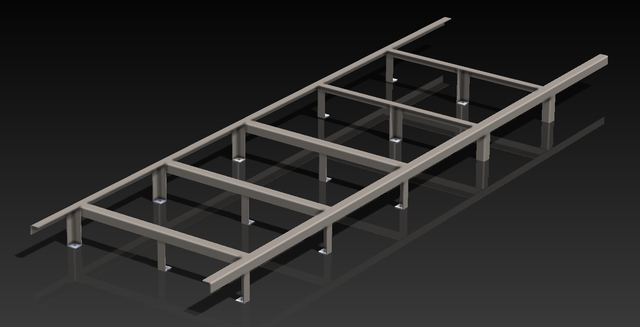
Weld Integrity & Compressional Stress Paths
A core objective during structural development was to completely isolate severe operating stress away from connection weld points. Real-world weld stress is notoriously difficult to simulate accurately and even harder to guarantee over decades of heavy service.
To eliminate this point of failure, the framework layout explicitly utilizes clever stress paths. These paths route the heavy downward forces directly through the structural steel elements in pure compression. By forcing the raw material itself to bear the structural load, the welds simply hold the assembly square and unified rather than acting as primary load-bearing joints.
Initial High-Stress Identification
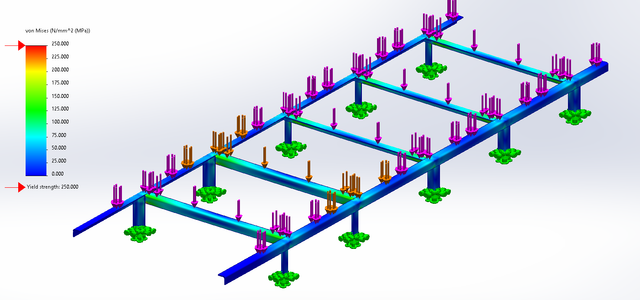
Due to the catastrophic risks of fluid structural failure, the client opted to run a full Finite Element Analysis (FEA) load simulation on our initial unassisted baseline frame layout.
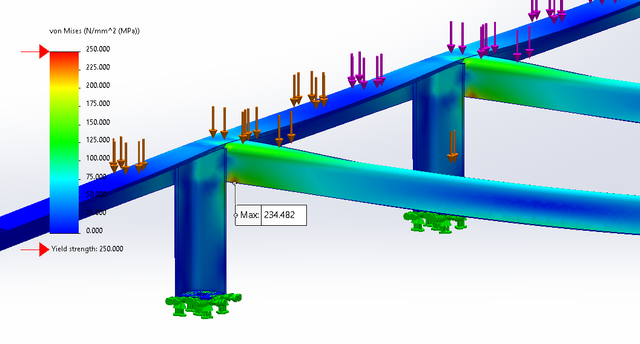
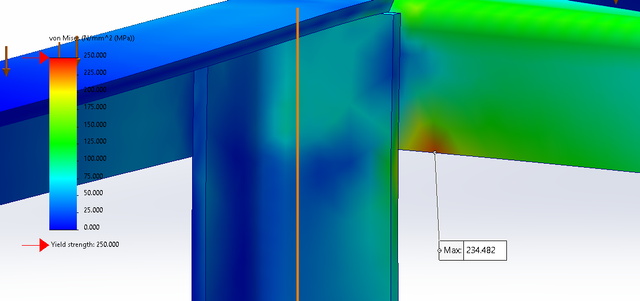
The initial stress heatmaps exposed a major structural bottleneck. Without a center support, the localized force concentrated along the width bars spiked up to an intense **234.48 MPa**. Because the typical yield strength of the chosen structural steel is 250 MPa, this initial draft left a dangerously thin margin of safety.
Before & After Optimization (Identical Scale Visual Check)
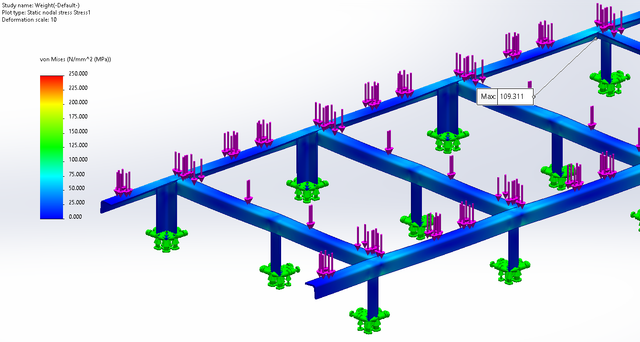
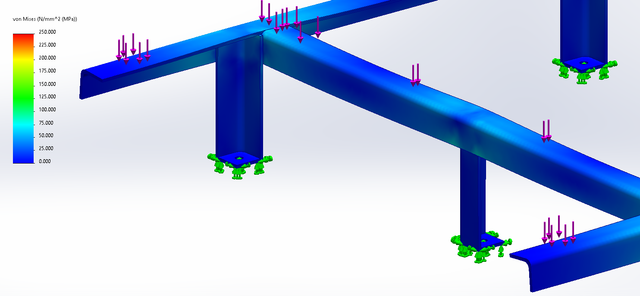
To provide clear engineering confirmation, both simulation runs below utilize the exact same color chart boundaries and maximum scale values. This allows for a direct, apples-to-apples visual evaluation of the structural load redistribution.
Engineering Refinement & Prevention
In professional heavy engineering design, keeping active operational stress to less than half of the material yield strength is a standard safety factor. Following an evaluation of the initial heatmaps, we integrated a strategic central load-bearing supporting leg directly underneath the crossbar array.
This simple design adjustment dropped peak internal material stress down to a perfectly safe **109.31 MPa**, successfully meeting our safety criteria. Simulating structural limits during development saved this client the massive headache of trying to weld open metal fractures underneath loaded fuel tanks down the line.